Pages

Tuesday, January 27, 2015

Ensemble Analysis - Kimono Jacket and Dress


This kimono style jacked is fully reversible with a seam that runs entirely down the back. It is made of fine black silk on one side and the other  side is green an black with an intricate print detail with obvious Japanese influence. The print inside is of a nature garden with a small stream flowing through. There is also Asian script on the inside, all of which is unrecognizable to myself. The kimono is silk screened with a dollar sleeve. Arm openings are towards the top of the sleeve. On the black side, there are five emblems that are woven on the middle back, back of the sleeves, and the front left and right sides. The emblems look like little leaves or unfamiliar flowers. Underneath the kimono jacket is a dress that is empire waisted, meaning the fabric is fitted just under the bust and flows down from there. The dress looks almost as if it is painted, it reminds me of learning about how traditional kimonos take about two to three years to complete because of the various steps it takes to paint the fabric and fully construct the entire thing. The empire waist leads to two straps that tie in the back. This dress has a thick black border that runs along the bust line and around the neck. This border also runs down the middle of the front of the dress and along the bottom of the dress as well. This dress as a similar sleeve as the kimono style jacked it is paired with. The sleeves look like they are dolman as well, but the arm opening consists of the entire sleeve. All together both garments fit a dress form that looks like it is approximately a size six. This ensemble stylistically works because I can see the influence of Japanese culture in both garments, if worn solely on the black side then the kimono jacket looks great with the dress because they look like they are a part of a set.


This Dress Has a Story

There, it was me. I took a second to think to myself because I’m absolutely sure that i could have handled things differently. My life was about to take a turn for the worst and it was all in the name of being a beauty queen. Let the interrogation begin..

My name is Stassi Torrinatta and this year I set out to be to most popular gal in Jersey by winning the turnpike queen at the All Star Miss Jersey pageant of 1988. As a competition girl, I’ve competed in over 400 pageants all around the country since I was about 5 years old. Theres a certain essence and bronze quality about a Jersey pageant queen and I had the take the title this year. My mother, a dignified Italian homemaker, always sought out activities that would make her look like a great parent and honestly, with all the titles I’ve won, I would say I truly pushed her image to greatness. We never really got along but we always tried to compromise since it was just us. My father works in Long Island doing some business type work, we have no idea what it is exactly that he does because we never see him. He stays in the city ninety five percent of the time and pays the bills back home, great father but a terrible dad. 

Now about a month before the big day my mom took me to the city to find a dress, going into the city is always an adventure because New York has a distinct presence. Its dirty, over populated, filled with all kinds of people that speak over one hundred different languages but its still the the land of opportunity and freedom. I dreamed of those things every night it seemed like. We arrived with intentions to shop the four B’s: Barney’s, Bendel’s, Bergdorf’s and Bloomingdales. After hours and hours of sifting through designer gowns and some of the latest credit card permitting couture (thanks to dad) I was exhausted and still dress-less. It wasn’t until walking down a little street not too far from fifth avenue that I saw a dress in the window of a tiny boutique, Avalon. The dress was everything and more for someone fun like myself. It was a far cry from the couture I had previously tried on. It was made of polyester and lustrous metallic and not to mention pink. There was a ruffle than was sewn from the waist all the way down to the bottom. I knew this was it, I mean its the 80’s, metallic and outrageous was ok especially for a beauty pageant. I tried the dress on and it fell sexily at my calves, just enough so my shoes could have some of the spotlight as well. As soon as I put the dress on the lady working in the shop said that she actually made the dress herself for a friends daughter who never ended up wearing it. Much to my luck since she was the seamstress she was able to quickly sew two straps on for me, just to reassure my girls stayed properly in place all night. She even gave me extra fabric that I used to fold and attach it to part of the bust for extra gaudy va-va-voom. 

Once the dress and shoes were finalized in my decisions, that week flew by and suddenly I was prepping backstage for my debut on stage as a contestant. I doused my bangs in hairspray and continued to tease the back of my mane till it was up to par. It wasn't until Rebecca Mac walked in and fiercely ruined my vibe. Rebecca was the only girl I can honestly say I hated, her family was just as privileged as mine but her attitude made her the worst bitch you could ever imagine. And just then, my mood shifted from being on cloud 9 to wanting her 6 feet under…


To be continued…

Monday, January 19, 2015

Response - Oprah and the View from Outside Hermes’ Paris Door

While reading ‘Oprah and the View from Outside Hermes’ Paris Door’ by Robin Givhan I immediately felt a connection to this article. For one I am a woman of color, and although I do not have the luxury of walking into an Hermes store front nor do I have the opportunity and privilege to purchase anything, I do have the conscious feeling some people of color experience when walking into a store that is more ‘high end’ than most. Oprah being one of the richest African Americans in the world had made a living by trying to connect to the general public, by giving back and by connecting to/with all kinds of people, cut from many different cloths. So why does it have to be a white and black issue? That’s the same question I’ve asked myself about the current events surrounding the Ferguson riots and Treyvon Martin incident etc. I wish it wasn’t something that was so racially related. The first half of this article even talks about how this incident was fabricated and told as if the staff did not know Winfrey and had no care to tend to her shopping wants. We live in a world where unfortunately people are so quick to pin anything as racist when there is conflict. Like Givhan writes, Hermes could have been treating Oprah like a regular customer, specifically going by the rules and company protocol—but its Oprah, a woman who has had such a great influence on many people in the world and has done a lot for them as well (aside from the incident where she gave free chicken to the black community a few years ago, that didn’t sit right with me). This one is tough for me opinion wise, because even if they said there was no racial underpinning there are still those thoughts in the back of my head about the ‘what ifs’. I feel like Oprah and her team had to right to think it could have possibly been a race issue. Now whether it’s Hermes or Wal-Mart, let’s not let being colorblind erase the struggles and somewhat familiar instances one goes through as a person or woman of color.

- Regan Mason


Response - Making of a Geisha

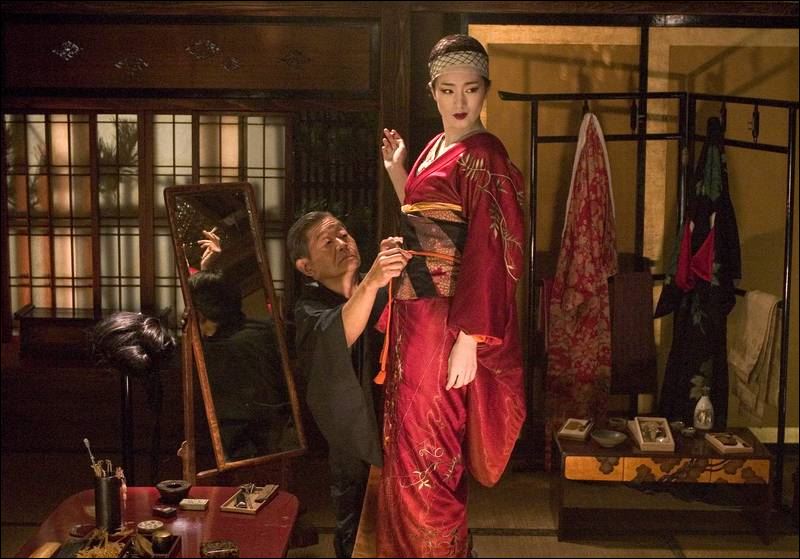
The making of a geisha featurette served as a great tool for a look behind the scenes. The feature was a pleasure to watch for me because personally I knew absolutely nothing about geishas prior to seeing this. In the 1930’s geishas were the fashionistas of their time and are seen as very traditional Japanese figures to this day. Colleen Atwood (costume designer) decided to modernize the traditional kimono for the film and because of that she won an Oscar in 2005 for her designs. Because of modernized costumes and makeup the film took a very fashion forward approach to telling the story of real geishas.

When capturing historical moments on film there is usually a huge concern about being historically accurate. Colors and styles of the kimono can vary for the season and events the geishas are attending. I can appreciate that the artists decision to have fun with the characters and what they were wearing. There was a moment when one of the makeup artists gave one of the actresses a traditional face and they didn’t like how the palette translated to film. She had to say to herself that they were all there to make a film not a documentary. The beauty then became more modern as they played with color and texture. It was almost as if everything suddenly came to life. “It’s a seduction, there’s a beautiful way of returning to a time.”

I felt that the costuming told a perfect story of fashion and history. I looked up a few points about the movie and discovered there was even an exhibit held at the Fashion Institute of Design and Technology because of Atwood’s Oscar winning designs.  Part of what was so moving is that traditional kimonos can take anywhere from two to three years to complete because of the intricate process that includes sewing, embroidering and painting the silk that makes up the garment. The design team for the movie didn’t have that kind of time and yet still managed to make some that were just as beautiful if not more. The statement of tradition and fashion was made and ended up very well received.

- Regan Mason